Session Seven: 10 Steps to Food Labels
Go to any grocery store and you are bombarded with choices. Which type of cheese has the least amount of fat? Which type of cereal is a good source of fiber? What’s the difference between skim and whole milk? Which fruit has more vitamin C—canned applesauce or peaches? You’ll find the answers on the Nutrition Facts Food Label. Labels tell a lot about food. They don’t suggest what foods to eat—that’s your decision. But labels can help you make your “personal best” food choices—choices that benefit you as you pursue your fitness goals.
Discover how any food - including your favorites - can fit into a healthful diet in sensible amounts. Maximize your trips to the grocery store by using labels to make healthy food choices.
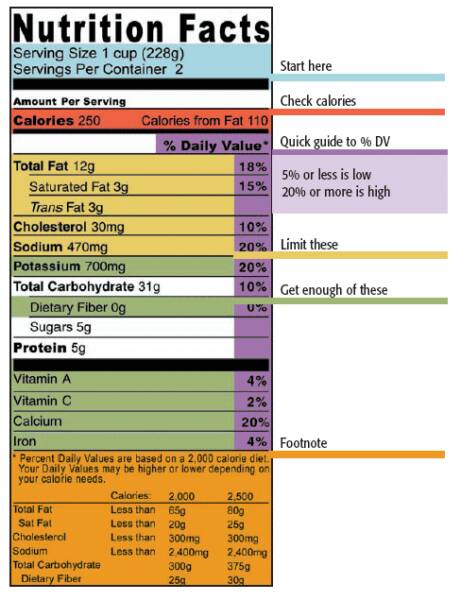
1. Start with the Serving Size
The first place to start when you examine the food or nutrition label is the serving size and the number of servings in the package. Serving sizes are standardized to make it easier to compare similar foods; they are provided in familiar units, such as cups or pieces. The size of the serving on the food package influences the number of calories and all the nutrient amounts listed on the top part of the label. Pay attention to the serving size, especially how many servings there are in the food package. Then ask yourself, "How many servings am I consuming"? If the label says one serving equals one cup and the whole package contains two servings, that doubles the calories and other nutrient numbers if you eat the whole thing.
2. Check the Calories
The calorie section of the label can help you manage your weight (gain, lose or maintain.) The number of servings you consume determines the number of calories you actually eat. In the sample label, there are 250 calories in one serving. How many calories from fat are there in ONE serving? What if you ate the whole package?
3. Limit These Nutrients
The nutrients listed first are the ones we generally eat in adequate amounts, or even too much. Eating too much saturated fat, trans fat, cholesterol, or sodium may increase your risk of certain chronic diseases, like heart disease, some cancers, or high blood pressure. Important: Keep your intake of these nutrients as low as possible. Limit sodium to no more than 2400 mg a day, cholesterol to 300 mg and avoid foods that have more than 2 grams of saturated fat.
4. Carbohydrates
Carbohydrates include sugars, complex carbohydrates, and fiber. A quality carbohydrate should also have fiber and sugar. Try to avoid carbohydrates with zero fiber. A quality carbohydrate has at least 1/6 as fiber – For example; 20 grams of carbohydrate would have around 3 - 4 grams of fiber.
5. Sugars
Sugars include naturally occurring sugars such as fructose in fruit and lactose in dairy products as well as added sugars such as sucrose (table sugar). Nutritionally they are just simple carbohydrates that are just contributing empty calories.
6. Proteins
As much as I preach about protein intake, most Americans get more protein than they need. Where there is animal protein, there is also fat and cholesterol. Eat small servings of lean meat, fish and poultry. Use skim or low-fat milk, yogurt and cheese. You can also mix in vegetable proteins like beans and grains.
7. Nutrients to Increase
Most Americans don't get enough dietary fiber, vitamin A, vitamin C, calcium, and iron in their diets. Eating enough of these nutrients can improve your health and help reduce the risk of some diseases and conditions. For example, getting enough calcium may reduce the risk of osteoporosis. Eating a diet high in dietary fiber promotes healthy bowel function and promotes weight loss. Additionally, a diet rich in fruits, vegetables, and grain products that contain dietary fiber, may reduce the risk of heart disease. Aim for 20 to 35 grams of fiber a day.
8. Footnotes
This part tells you the amount you should get of each nutrient if you take in 2,000 or 2,500 calories in one day. When the full footnote does appear, it will always be the same. It doesn't change from product to product, because it shows recommended dietary advice for all Americans--it is not about a specific food product.
9. Daily Values
The % Daily Values (%DVs) are based on the Daily Value recommendations for key nutrients but only for a 2,000 calorie daily diet. Use the % DV as a frame of reference based around the calories you consume, even if they are more or less than 2,000 calories. Anything that is 5% DV or less is low for all nutrients, you want to limit these (fat, saturated fat, cholesterol, and sodium), and for those that you want to consume in greater amounts (fiber, calcium, potassium etc.) the label shows, 20% DV or more is high for all nutrients.
Example: Look at the amount of Total Fat in one serving listed on the sample label. Is 18%DV contributing a lot or a little to your fat limit of 100% DV? It is 18%DV, which is below 20%DV, not yet high, but what if you ate the whole package (two servings)? You would double that amount, eating 36% of your daily allowance for Total Fat. Coming from just one food, that amount leaves you with 64% of your fat allowance (100%-36%=64%) for all of the other foods you eat that day, snacks and drinks included.
10. Finally, Check the Ingredients List
Ingredients are listed in descending order of predominance. This means that the first ingredient is the most prevalent in the product, while the last ingredient has the least amount in the product. The ingredient list can help you identify 'hidden' ingredients, like added sugars, trans-fats (hydrogenated oils) and coconut oil or palm oil, which are high in saturated fat.
Ingredient List Red Flags:
- Enriched anything. Enriched means the food was stripped of vital nutrients.
- A protein where the fat calories are half of or more than the total calories (unless, of course, you are looking at a bottle of olive oil)
- A carbohydrate where sugars are half or more of the total grams of carbohydrates (ex. Carbohydrates 12g, sugars 6g.)
- Avoid partially hydrogenated oils (also known as trans-fatty acids) and hydrogenated oils (as opposed to partially hydrogenated).
Fitness Journal Assingment:
Complete while comparing at least 2 food labels from home
1. What information do you look at first? Why?
2. Which item has the most calories per serving?
3. Which item has the largest amount of fiber?
4. Which item has the least percentage of total fat?
5. Which item has the largest percentage of sodium?
6. Which item has an abundance of vitamins?
7. How will reading labels help you to eat more supportively?
Want Your Own Personalized Total Body Transformation Program?
Get Your Very Own Complete Tailor-Made 8-Week/2-Phase
Total Body Transformation Program
Personalized Manual!
James Cipriani
Cutting Edge Personal Training